
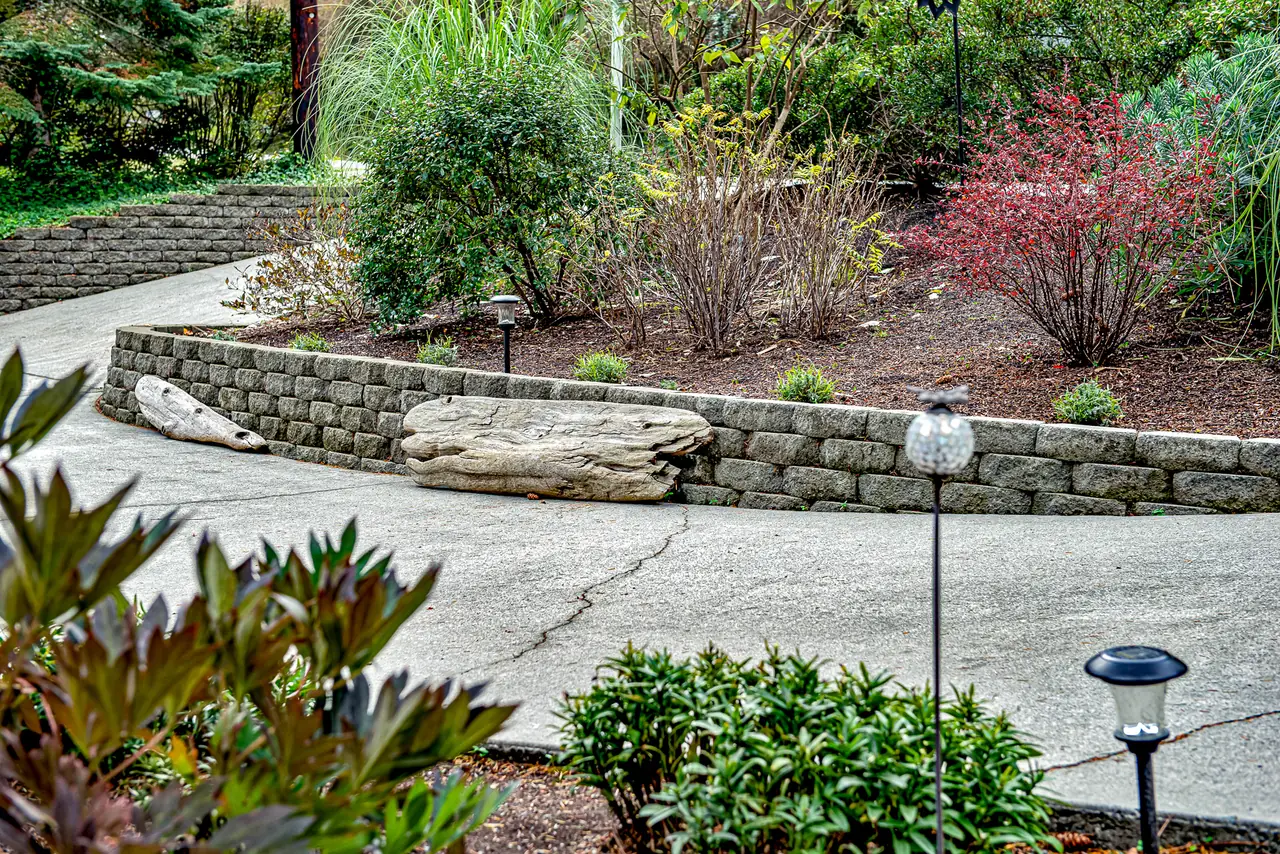
How Much Does a Retaining Wall Cost in the Sacramento Valley?
Most people pay $3,500 to $9,400 for a retaining wall, says one national cost guide updated in October 2026. Its national average is $6,300. Per square foot of wall, it puts most walls at $20 to $53. A second guide, updated the same month, lists $3,565 to $9,645, with an average of $6,000.
These are market numbers, not our price list. Trinity Paving and Concrete builds block and stone retaining walls along driveways and slopes around Dixon. A wall’s height moves its price, and the permit rules start with height too.
How much does a retaining wall cost by height and length?
An older national guide, last updated in January 2025, prices walls by length and height. Its prices include labor.
| Wall height | Per linear foot | 25-foot wall | 100-foot wall |
|---|---|---|---|
| 2 feet | $40 to $120 | $1,000 to $3,000 | $4,000 to $12,000 |
| 4 feet | $80 to $240 | $2,000 to $6,000 | $8,000 to $24,000 |
| 6 feet | $120 to $360 | $3,000 to $9,000 | $12,000 to $36,000 |
The per-foot column divides the 100-foot prices by 100. Each price works out to $20 to $60 per square foot of wall face, which is length times height. The second guide puts a 50-foot wall, 2 to 6 feet tall, at $2,000 to $17,250.
Where the wall goes matters too. The first guide lists $38 to $138 per linear foot for a wall along a driveway. A wall on a slope runs $40 to $200 per linear foot.
How much does each type of retaining wall cost?
The first guide also prices walls by material, per square foot of wall face.
| Wall type | Cost per square foot of wall face |
|---|---|
| Interlocking block | $15 to $35 |
| Cinder block | $15 to $40 |
| Landscape block | $15 to $60 |
| Natural stone | $20 to $90 |
| Poured concrete | $20 to $40 |
| Wood | $13 to $35 |
The second guide’s material prices include labor. It lists stone at $15 to $95 and concrete at $20 to $55 per square foot. Trinity Paving builds block and stone walls. The poured concrete and wood rows are there for comparison.
For a rough figure, multiply the wall’s length by its height, then by a price from the table. A 50-foot wall that is 3 feet tall has 150 square feet of face. At $15 to $35, interlocking block comes to $2,250 to $5,250 before the extras below.
What drives the price of a retaining wall?
- Height and length. A larger wall costs more in material and labor, one guide says. Walls over 4 feet and concrete walls typically get steel rebar, another says. That adds $1.50 to $2.50 per square foot.
- Footing and base. Gravel goes into a wall’s footing and its backfill. One guide puts concrete footings for taller walls at $18 to $55 per linear foot. Our walls start on a compacted base.
- Drainage behind the wall. Water builds up on the back side of a retaining wall and presses on it. Basic drainage is perforated pipe at the base of the wall, gravel backfill and weep holes. A French drain cost guide prices a drain behind a retaining wall at $25 to $50 per linear foot. Our walls get drain rock and perforated pipe behind them, with outlets for the water. We also do the grading and drainage around them.
- Clay soil. Capay clay covers parts of the Dixon area and the valley floor at Vacaville and Fairfield. The federal soil survey says it has cracks that open and close at least once each year. It drains slowly, so water stays behind a wall unless a drain carries it off. One guide says clay-heavy soil takes more digging, which can raise labor costs by up to 50 percent.
- Access for equipment. Machines work well on easy-to-reach sites, while tight spaces take more hand labor and time. Labor makes up 40 to 60 percent of the total, one guide says.
- Tearing out an old wall. A replacement adds the tear-out. One guide puts that at $15 to $30 per linear foot, plus disposal fees.
- Engineering. A tall wall, or one that holds up a driveway or a slope, may need an engineer’s design. One guide puts engineering fees at $500 to $2,000 or more. In Dixon, any wall that needs a permit needs stamped plans from an engineer or an architect. Walls built to a city-approved design are the exception.
Do you need a permit for a retaining wall in the Sacramento Valley?
California’s building code exempts a retaining wall that is not over 4 feet tall from a building permit. That rule is Section 105.2 of the 2025 code, which took effect January 1, 2026. The height runs from the bottom of the footing to the top of the wall. Say a wall shows 3 feet above the ground, and the bottom of its footing sits 1.5 feet down. By the code’s measure it is 4.5 feet tall, so it needs a permit.
The exemption ends when a wall supports a surcharge, an added load on the soil it holds back. Dixon’s retaining wall handout counts sloping soil above the wall. It also counts a building’s footings or cars on a driveway resting on that soil. Dixon sets a lower line near slopes, too. On or within 10 feet of a slope of 5:1 (20 percent) or steeper, the line drops to 30 inches. That height also runs from the bottom of the footing.
For a permitted wall, Dixon’s handout calls for a 4-inch perforated drain line and a 12-inch gravel pocket behind it. It requires weep holes or solid outlets. Water may not drain onto adjoining properties or walkways.
Solano County’s building office prints the same 4 foot rule. Cities and counties may amend it or apply it differently. Woodland is one example. A city page there says to get a building permit for retaining walls and names no height cutoff. Check with your city or county building office before the wall goes in. We point you there when we look at the job.
How do you get a written quote for a retaining wall?
Published ranges are a starting point. The wall’s height from the footing up, its length, the drainage, the soil and the access set the real number. A written quote should show each of those, plus any tear-out.
Trinity Paving works out of Dixon and builds block and stone retaining walls within about 40 miles. We look at the slope and the access, then put the quote in writing. See how we build retaining walls, or call or text (707) 396-7730.